
You notice it on a Monday morning in November. The hallway from the lobby to the break room has two dull grey lanes where people walk, the edges along the wall have turned a shade of yellow, and the whole floor looks tired no matter how often it gets mopped. Then a commercial floor cleaning vendor walks through your Bellevue or Seattle building and says the words every facility manager has heard: "These floors need a strip and wax."
Sometimes that is exactly right. Just as often the floor only needs a scrub and recoat, which costs a fraction of a strip and has the space open again the next morning. And some floors should never see wax at all, no matter who offers it. Here is how to tell the difference, how often each kind of floor really needs the full treatment, and why the rainy half of the year in Puget Sound sets the schedule more than anything else.
The short answer
If your building has VCT, the 12-inch vinyl tile in most offices, clinics, schools and back rooms, most floors need a full strip and refinish about once a year. A quiet suite with private offices and a conference room can go 18 to 24 months between strips if it gets a scrub and recoat once or twice a year in between. A clinic waiting room, a school corridor or a busy break room usually needs the strip every 12 months, with a scrub and recoat each quarter and a burnish each month. A store entrance, a cafeteria or a gym lobby that sees a few hundred people a day is the other extreme: a strip every 6 to 12 months, a scrub and recoat every month or two, and a burnish every week just to keep up.
Treat those intervals as a starting point, not a rule. The companies that make the tile do not give a date at all: their care sheets say to strip when the floor is badly soiled or scratched, or when the gloss looks worn and uneven. Contractor guides land in the same range, from a strip once a year, or every four to six months on heavy traffic, to a slower rotation where about a quarter of the building is stripped each year and the rest is scrubbed and recoated. The honest rule for your building is the one the manufacturers use: look at the floor, not the calendar. The rest of this article shows you what to look for.
What a strip and wax actually is, and what the cheaper options do
Floor care is a ladder with four rungs. Most expensive floor problems come from skipping the lower rungs and then paying for the top one too often.
Nightly care is a dust mop followed by a damp mop or an auto-scrubber with a neutral cleaner. It is the least glamorous work on the list and the most important, because it removes the grit that scratches finish. A floor that is dust mopped every night keeps its shine for months longer than one that is not.
Burnishing is a high-speed machine with a soft pad that heats and hardens the top layer of finish and brings the shine back. It does not add anything to the floor, so it only works while there is still finish to polish. If your floor looks dull but even, this is usually all it needs.
A scrub and recoat is the middle option that vendors mention least often. An auto-scrubber with a slightly more aggressive pad takes off the top one or two coats of scuffed finish together with the ground-in soil, and two fresh coats go on. It only works if the floor has four or five coats on it to begin with, which is one more reason to keep the floor coated properly. Your space is back in use the next morning, and the heel marks and grey lanes are gone.
A strip and refinish is the full reset. Chemical stripper dissolves every coat down to bare tile, the slurry is picked up, the floor is rinsed and neutralized, and three to five new coats go on with drying time between each. Stripping alone takes a crew about two to three hours per 1,000 square feet, which is why it is a Friday night or weekend job.
Here is the part that matters for your budget. When a floor starts with four to six coats, everyday wear only damages the top one or two, so most strip jobs remove finish that is still in perfectly good shape. A building that scrubs and recoats on schedule strips less often, spends less on labor and chemicals, and keeps its tile longer. Stripping too aggressively has a cost of its own: tile makers warn against harsh strippers on floors less than two years old, because they can loosen the adhesive underneath.
Which floor do you actually have?
Strip and wax is only for floors that take a sacrificial acrylic finish. A lot of floors in newer buildings do not, and waxing them creates problems instead of solving them. Here is what each one wants from you.
VCT. Porous, inexpensive and dull without finish; this is the floor strip and wax was invented for. The care sheets from both Armstrong and Tarkett call for three to five coats of finish before the floor goes into service. If you have VCT, the schedule above is for you.
Sheet vinyl and linoleum. Exam rooms, cafeterias, corridors. Most sheet vinyl is cared for like VCT, but check the care sheet first; some manufacturers say their sheet vinyl needs no finish at all.
Luxury vinyl plank (LVT or LVP). The wood-look and stone-look planks in almost every office built or remodeled in the last ten years. Shaw's maintenance checklist calls finish optional and warns that once you apply it, the finish becomes the wear layer you have to keep up forever. LVT wants a dust mop, a neutral cleaner and a periodic machine scrub, not a strip and wax cycle. If a vendor proposes one, ask for the manufacturer's care sheet.
Ceramic and porcelain tile. Restrooms, lobbies, restaurant dining rooms. Glazed tile gets a neutral or alkaline cleaner, never a wax or oil based product. What needs protecting is the grout, not the tile; seal it and keep acids away from both.
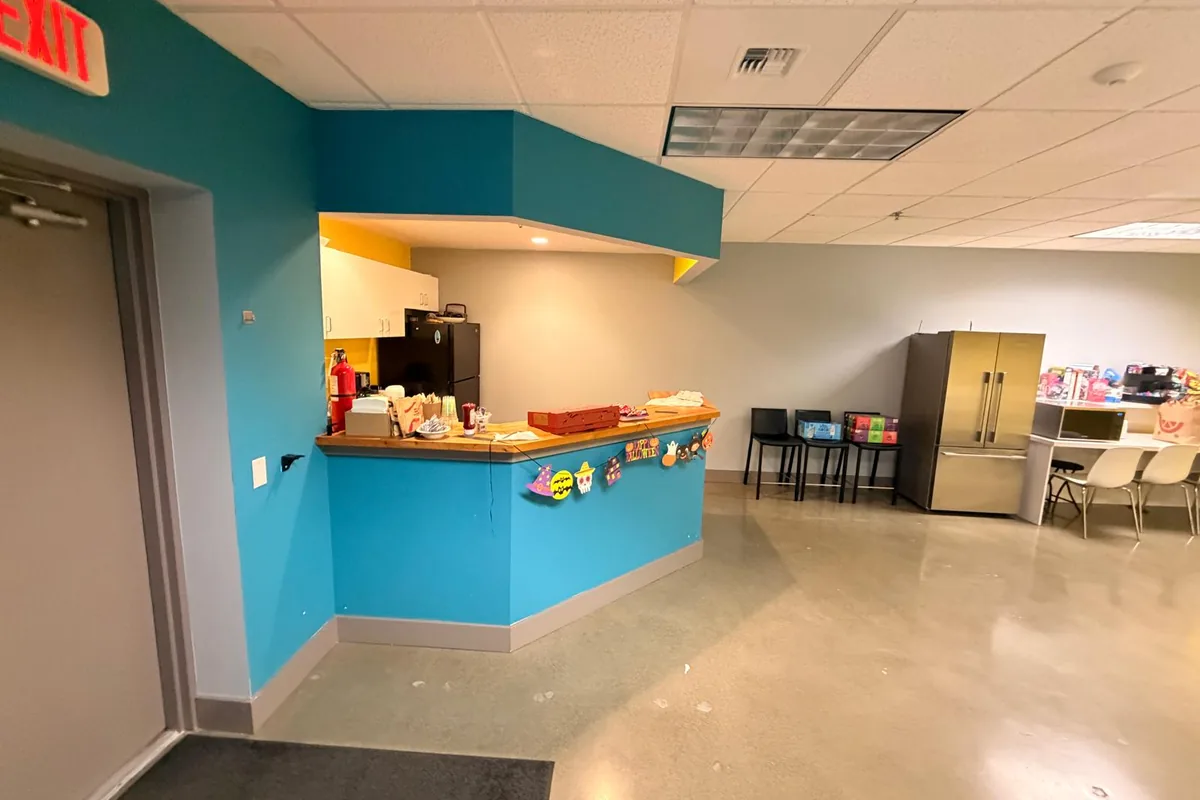
Polished or sealed concrete. Warehouses, breweries, and modern offices like the lunch area in the photo above. No acrylic finish goes on these floors. The maker of the densifiers used on them recommends daily dust mopping, a dry burnish every week or month, and a fresh coat of guard about twice a year, and never an acidic or alkaline cleaner.
Rubber and sport flooring. Gyms and play areas. A neutral or rubber-specific cleaner; most makers do not recommend finish.
Not sure which one you have? Look at a worn traffic lane in good light. VCT with old finish shows a dull band with a visible edge where the polish has worn through. LVT shows fine scratches but no finish edge. Tile shows dark grout lines rather than dull tile.
Why floors in Seattle and Bellevue wear faster from October to March
The weather is the biggest local variable in a floor care plan, and it is easy to put numbers on it. Sea-Tac averages 39.3 inches of rain and 156 days a year with measurable precipitation in NOAA's 1991 to 2020 climate normals. Three quarters of it falls between October and March; November is the wettest month, and January has the most wet days, nearly 19. Every wet shoe brings fine grit into your lobby, and grit under foot works like sandpaper on finish. Standing water softens acrylic finish and leaves rings.
When it does snow, the city pre-treats streets with salt brine and spreads salt as the snow falls. The residue walks in as a white haze. A neutral cleaner removes it, as long as the floor is mopped more often that week.
The fix for all of this starts at the door. The LEED v4 air quality credit asks for a permanent entryway system at least 10 feet long, maintained weekly, and the Carpet and Rug Institute's commercial standard says mats 9 to 15 feet long inside the door catch about 80 percent of the soil and moisture from the first few steps. Mats only work if they are vacuumed every visit and swapped when saturated, so put that in your janitorial scope.
Commercial floor cleaning schedule by traffic level
Once you know the floor and the traffic, the schedule writes itself. Use this table for VCT and other finished resilient floors, then let the condition of the floor move the dates.
| Traffic level | Typical areas | Dust and damp mop | Burnish | Scrub and recoat | Strip and refinish |
|---|---|---|---|---|---|
| Light | Private offices, conference rooms, small suites | Every visit | Monthly to quarterly | 1 to 2 times a year | Every 18 to 24 months |
| Medium | Waiting rooms, school hallways, break rooms, small retail | Nightly | Monthly | Quarterly | Every 12 months |
| Heavy | Store entrances, cafeterias, gym lobbies, main corridors | Nightly, sometimes twice | Weekly | Every 1 to 2 months | Every 6 to 12 months |
For LVT and sheet vinyl without finish, Shaw's chart is a good template: light areas get dust mopped two or three times a week, wet mopped weekly and machine scrubbed quarterly; moderate areas get daily dust and wet mopping with a monthly scrub; entrances, elevators, main hallways and break rooms get daily cleaning and a weekly scrub.
The trick is to zone the building. A law office in downtown Bellevue might have a heavy-traffic lobby and corridor, medium-traffic break rooms and light-traffic offices, all on the same VCT. Strip the whole floor on the lobby's schedule and you waste money. Strip it on the offices' schedule and the lobby fails.
Signs you need a strip, not another coat
A floor that is dull but even usually needs a scrub and recoat. These signs mean the finish has to come off:
- Dark traffic lanes that burnishing no longer brightens.
- A yellow or amber band along the walls and under furniture, where coats have built up for years without wear.
- Powdering: white dust that appears after burnishing.
- Peeling or flaking, which usually means finish went on over soil, over a different product line, or over a floor that was not rinsed.
- Scratches you can feel with a fingernail in the finish rather than in the tile.
- Nobody can remember the last strip, or the floor has had more than five or six recoats since.
Two things often mistaken for "time to strip": a floor that was never burnished (one burnish visit brings the shine back) and a floor with heel marks (a scrub and recoat removes them).
What it costs around Seattle
Floor work is priced per square foot, and the national ranges published over the last year are fairly consistent. The cleaning industry association ISSA lists strip and refinish at $0.30 to $0.60 per square foot and scrub and recoat at $0.20 to $0.40 in its December 2025 guide, as general ranges rather than fixed prices. A 2025 bidding guide for contractors puts stripping and waxing at $0.24 to $0.55 per square foot. Thumbtack's 2026 cost guide quotes 70 to 75 cents per square foot for heavily trafficked commercial VCT, volume pricing down to 25 cents above 10,000 square feet, and a typical minimum charge of around $150.
What moves a quote inside those ranges: the condition of the floor, how much furniture has to be moved, the layout (many small rooms cost more per square foot than one open floor), the number of coats, and whether the work has to happen on a weekend. A scrub and recoat usually costs well under half of a strip for the same floor, which is why a program that recoats on time spends less per year than one that strips annually.
We price floor work after a walkthrough, as a flat price for the visit, and fold it into recurring programs for Bellevue and Seattle facilities. The hard floor care page describes what a strip and refinish, a scrub and recoat and a burnishing visit include, and the commercial cleaning cost page explains how recurring programs are priced. Call for a quote on your own floor rather than relying on the national ranges above.
Safety and compliance
Floor finish is a safety item, not just an appearance item. OSHA's walking-working surfaces rule, 29 CFR 1910.22, requires employers to keep floors "in a clean, orderly, and sanitary condition" and, to the extent feasible, dry, to keep them "free of hazards such as sharp or protruding objects, loose boards, corrosion, leaks, spills, snow, and ice," and to inspect them "regularly and as necessary."
During a strip, that means the area is closed and signed, the stripper is never allowed to dry on the floor, and the floor is rinsed and fully dry before anyone walks on it. After the last coat, follow the cure time on the finish label before rolling chairs and heavy furniture back in; the usual practice is to strip on a Friday night so the floor has the weekend.
Put the floor care plan in writing
Most tired floors in well-run buildings come down to one thing: nobody wrote the floor plan down, so the periodic work was left to "as needed," which in practice means "when someone complains." A workable scope has five lines:
- Nightly: dust mop and damp mop or auto-scrub all hard floors with a neutral cleaner; vacuum the entry mats.
- Periodic: burnish, scrub and recoat, and strip and refinish, each with a frequency per zone from the table above.
- Products: one finish line and one neutral cleaner, named in the scope. Mixing finish brands is the most common cause of peeling.
- Records: the date, the zone and the product for every periodic visit, so the next decision is based on history rather than guesswork.
- Review: a walkthrough with your vendor each quarter, with the mats, the traffic lanes and the edges inspected together.
If floors are part of a bigger program, the janitorial and custodial services and office cleaning pages show how the nightly work and the periodic floor work fit into one schedule, and the retail store cleaning page covers the sales floors and entrances that take the most punishment.
Frequently asked questions
Can luxury vinyl tile be waxed? Most manufacturers say finish is optional at best, and once you apply it, the finish becomes the wear layer. If a vendor proposes a strip and wax on LVT, ask for the manufacturer's care sheet first.
How many coats of finish should a VCT floor have? Three to five before the floor goes into service, according to both Armstrong and Tarkett. A scrub and recoat only works when four to five coats are on the floor, because it removes one or two.
Can a brand-new floor be stripped? Not right away. Armstrong says not to wet wash, machine scrub or strip VCT for at least five days after installation, and to avoid aggressive strippers on tile less than two years old. Shaw asks for four days before the first normal wet cleaning of LVT.
Get a floor care plan for your building
Premium Services WA provides hard floor care for offices, clinics, schools, stores, gyms and warehouses across Bellevue, Seattle and the Eastside, either as a one-time strip and refinish or as part of a recurring janitorial program with the burnishing and recoating built in. Book a free on-site walkthrough, get a written scope and a flat price before anything starts, or call (253) 632-8648 if you would rather talk it through first.